
GPS-collars in 2025:
an invaluable tool to study wolves
By Austin Homkes
Field Biologist

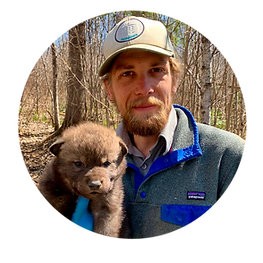
One of the most important tools we use to study wolves in the Greater Voyageurs Ecosystem (GVE) are GPS collars. Without GPS collars, we could never find dens to count and tag pups, or locate kills and other areas wolves were scavenging to understand what wolves eat, where they eat it, and how often. We would never uncover interesting behaviors, such as wolves lying in wait to ambush beavers or the areas where they gobble down blueberries every summer. We would never understand what wolves in this ecosystem die from, or where they go when they leave our study area. Without GPS collars, we would be limited to studying wolves primarily with trail cameras, which, while very informative, only give us a limited view into the cryptic lives of the wolves in the GVE.
The battery in a GPS collar, like all batteries, has a limited lifespan. After a couple of years, the GPS collars we put on wolves eventually run out of battery life and stop functioning. Just before they run out of power, however, a programmable mechanism in the collar, called a “drop-off device”, causes the collar to fall off the wolf so we can collect the collar, install a new battery, and redeploy it on another wolf. As a result, while we put collars on several wolves each year, we also have collars that drop off of wolves each year too (and of course, some wolves die as well).

Wolf Y15C, the new breeding male of the Half-Moon Pack, waking up after being collared.
Putting GPS-collars on wolves is difficult and time-consuming work because wolves avoid people and are wary animals by nature. To collar wolves, we first have to catch them. We do that by using rubber-padded foothold traps that have been substantially modified for the safe capture and release of the wolf. Once a wolf is caught, we sedate the wolf for about 30-45 minutes, which is enough time for us to ear tag and collar the wolf, take measurements, and collect biological samples. After this process is complete, the wolf wakes up, heads into the woods, and after a short period is back to its normal life.
The summer of 2025 marked the 11th season that we collared wolves in the GVE. Each of the years we have collared wolves two things have remained the same: capturing wolves is difficult and you never know which wolves you will catch. Although we have specific wolves we would prefer to collar in certain packs, we have little control over which wolves we catch.

Wolf Y8L after being collared during one of our early morning captures.
In general, the most beneficial wolves to collar are the breeding male and female of each pack. These wolves are most likely to stay in their territories the longest, and breeding wolves show us where den and rendezvous sites are because they are the primary wolves raising the pups. However, these older wolves are generally more experienced and therefore more difficult to catch than their younger more gullible offspring. As a result, we generally are more likely to catch younger pack members than breeding individuals. Young pack members still provide invaluable data for us but they are more likely to disperse, meaning that at any moment they could just leave the GVE, at which point, they are of little help to us in understanding pack dynamics in the GVE. That said, a small percent of young wolves, typically young females, do stick in their packs for several years and can provide fantastic data for our research.
Additionally, about 20% of the wolves in the GVE are nomadic lone wolves, which do not belong to a pack. Although there is a great deal we would like to know about lone wolves, they are difficult to study because of their nomadic lifestyle—i.e., they are in our study one week and a hundred miles away the next week. For this reason, we generally do not want to catch and collar lone wolves, though it inevitably happens.

Wolf Y16T, a newly collared yearling of the Stub-tail Pack.
Our 2025 collaring season ended in mid-August. We caught and collared 10 wolves, which was a bit below average for us. We typically catch about 12 wolves/season, with our record being 18 wolves in a season. That said, the majority of the wolves we captured this year (9 out of 10) were members of packs, and not lone wolves.
Notably, one of the wolves (Wolf G10E) we captured was from a pack we have never had a collared wolf in before. Wolf G10E is the breeding male of the Wandering Pines Pack, the southernmost pack in our study area. The Wandering Pines Pack was a breeding pair last winter, Wolf G10E and his mate. His movements since we collared him in late July have already provided us with a good understanding of where the Wandering Pines Pack territory is.

Wolf G11E, the first black wolf we have ever collared with the project. Wolf G11E is also a lone, male wolf.
Another notable moment this year was when we caught and collared Wolf G11E, a lone wolf. Wolf G11E was notable because he was the first black wolf we have ever collared. Black wolves are very rare in the GVE, unlike in other areas such as the Rocky Mountains. We seldom observe black wolves on our 375 trail cameras, and there has not been a black wolf in any pack in the GVE since 2016! Wolf G11E was a 1- or 2-year-old based on tooth wear patterns—the typical age of lone wolves in our area. So far, he has wandered the outskirts of our study area, and with luck he will find a mate and set up a territory in the next year in our study area.
Each wolf we study is unique and each provides fascinating insights into the variation in wolf behavior and how wolves generally make a living in this part of the world. Almost all of the insights we glean from studying these wolves are made possible only because of GPS collars. The collars provide data that we cannot collect any other way. The wolves we have collared over the last 11 years have yielded a wealth of knowledge, but at the same time, what we have learned has also shown us how little we know and how much there is to discover still.